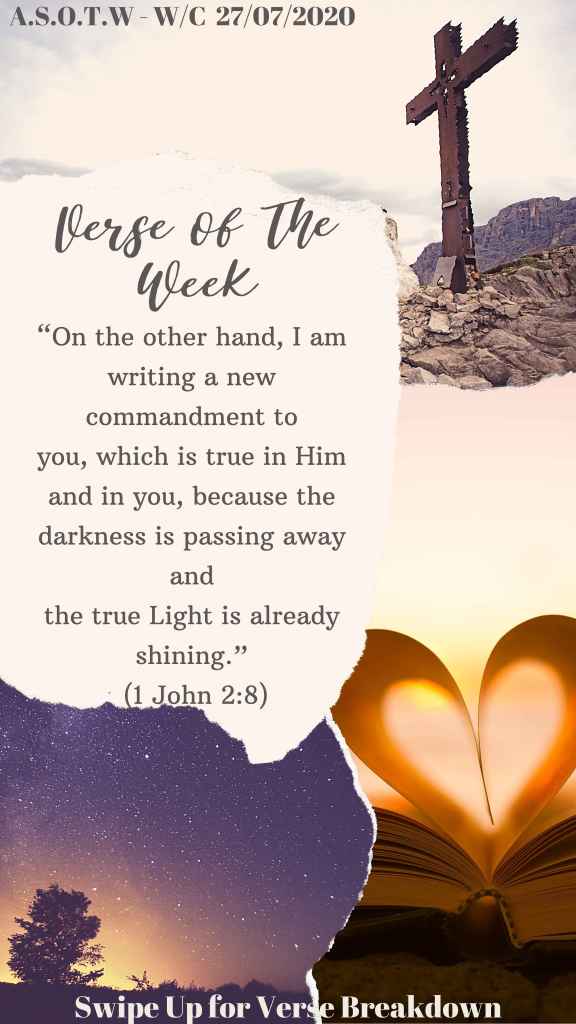
“On the other hand, I am writing a new commandment to you, which is true in Him and in you, because the darkness is passing away and the true Light is already shining.”
To provide some context, in John 13:34 Jesus said, “A new commandment I give to you, that you love one another, even as I have loved you, that you also love one another. By this all men will know that you are My disciples, if you have love for one another” and it would appear that these words of Jesus were behind John’s words about the old, new commandment.
What exactly is the “old, new commandment” and why did John feel the need to speak on the subject?
Some may suggest that John was motivated by those who constantly sought and claimed to have some “new” truths. Here, using an obvious play on words, John counters them, saying that we do not need new truth, but rather the old truth that his readers learned early in their Christian experience. On the other hand, if you want “new” truth, John says that the old commandment is the new commandment, which Jesus gave to us. This old, new commandment is as Jesus states in John 13:34, to love one another as Jesus loved us.
John Stott discusses the ways in which the commandment to love was new. He suggests the idea of love in general was not new, but Jesus Christ invested it in several ways with a richer and deeper meaning. First, it was new in the emphasis He gave it, bringing the love commands of Deuteronomy 6:5, which calls us to “love the Lord your God with all your heart and with all your soul and with all your might” and Leviticus 19:18 which states we “shall not take vengeance, nor bear any grudge against the sons of your people, but you shall love your neighbour as yourself.” Secondly, it was new in the quality Jesus gave it. A disciple was to love others not just as he loved himself but in the same measure as Christ had loved him, with selfless self-sacrifice even unto death. Thirdly, it was new in the extent He gave it, showing in the parable of the Good Samaritan that the ‘neighbour’ we must love is anyone who needs our compassion and help, irrespective of race and rank, and includes our ‘enemy’ (see Matthew 5:44).
One may also say that the Gospel preached to us is old, but the Gospel realised in us is always new.
“Christ set forth before our eyes is always old; but “Christ in us the hope of glory,” (Colossians 1:27)—“Christ dwelling in our hearts by faith,” (Ephesians 3:17)—Christ becoming more and more, through the Spirit’s teaching, part and parcel of our whole inner man—This Christ is always new.” (Robert S. Candlish)
When John says it “is true in Him and in you”, what does he mean?
It is “true in Him” because the Lord Jesus is the greatest example of love and fulfilment of such commandment in humanity’s history. Not only did He leave the splendour and perfect holiness of heaven, where He was able to enjoy complete fellowship with the Father, He came down this corrupt and sinful world, not as a political, conquering King, but as a lowly servant. Jesus was obedient to death on the cross at the hands of sinful men, all to save sinners who deserved His wrath. We cannot question that this new commandment is supremely true in Jesus.
“It is true in Him fundamentally and true in you derivatively because of your new relationship with Him. Paul often describes our new relationship as being “in Christ.” John uses the term, “abiding” in Him. The glorious truth of the New Testament is that we are joint-heirs with Christ of all His riches (See Romans 8:17; Ephesians 1:19-20; 2:6)!” (Steven Cole)
What about the darkness and the light?
In short, Jesus was the true light who came to bring spiritual light into the spiritual darkness of this world, continuing to shine this life changing light through the hearts of those who have become a new creation in Christ. We may therefore suggest Isaiah’s prophecy in Isaiah 60:1, which commands us to “Arise, shine; for your light has come, and the glory of the LORD has risen upon you”, while in context referring to Israel in the future Millennium, is also applicable to all believers in this present age.
MacDonald would suggest the darkness has not all vanished because many have not come to Christ, but Christ, the true light, is already shining, and whenever sinners turn to Him they are saved, and henceforth love their fellow believers. J Vernon McGee corroborates this stating “As you look around you today, you will see that the darkness has not passed yet. Ignorance of the Word of God is still much in evidence. The “true light,” who is the Lord Jesus Christ, is breaking upon this world.”
Of course, we may believe no matter how well we know God and His Word, we are not at the point where we can guarantee the darkness has already passed. But despite those feelings, we can rest assured that the darkness is passing, and the true light is shining. Every day we should strive to get to get to know the Lord better, and every day we should seek to understand His will more perfectly. Until the time comes when we see our Saviour face to face, there will still be a measure of darkness in us, but we must persevere in the belief that it won’t be long until all the darkness will be gone, and we will see everything in all its clearness in His own blessed presence.
 My Sunday Skl