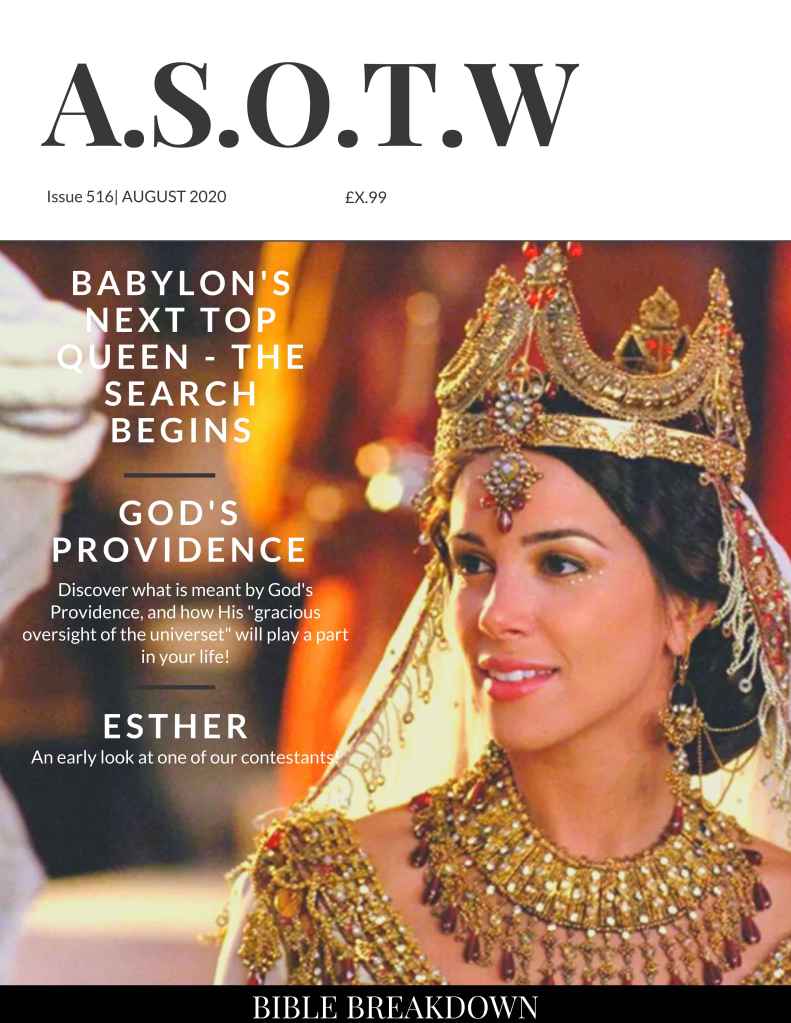
I’ve got a confession to make. I’ve always been a big fan of Reality TV competition shows. Whether they’re from the UK, US, Australia, heck, even South Korea. From Survivor to The Challenge. From the Genius to Big Brother. From Society Game to Hell’s Kitchen. From Love Island to Love Is Blind. I’ve seen many in my days on this Earth.
But why am I telling you this?
Well, when I first read the book of Esther, that is how it played out. Like a good Reality TV show from the perspective of our star, Esther. In fact, the name Esther literally means “star”, and when we first meet her, in Esther 2:7, she is introduced as a young lady who “was beautiful of form and face.”
Yet despite being blessed with beauty, Esther’s life started out as an uphill battle. She was Orphaned as a young girl and Esther, or should I say Hadassah, was later taken in by her relative Mordecai, raising her as his own daughter. Furthermore, we find Esther, not only orphaned but also living a difficult life as a minority, exiled in a foreign land as a result of Babylon falling to Medo-Persia (ca. 539 b.c.).
Is this like an underdog story then?
That may be a fair assessment. Through the harsh reality of Esther’s existence, a story has been preserved for over 2500 years. One of beauty, bravery, favour and at times, diva-like behaviour.
Diva-like behaviour?
For a change, how about we start at the end and work our way back.
Diva-like behaviour. When Esther was challenged to risk her own life and to potentially save the lives of many others, including that of her relative, she initially stalled. She hesitated. She pulled back. It was at this point that Mordecai challenged her to think beyond herself.
Mordecai said, “And who knows whether you have not attained royalty for such a time as this?” (Esther 4:14).
For such a time as this. I did not realise it was from the Bible.
This phrase is often used to encapsulate the power of personal destiny, appealing to the hope in all of us. Appealing to that deep desire to experience purpose and meaning beyond our own understanding. Beyond our own abilities and decisions.
Who wouldn’t want to be able to say: “I was created for this”?
Maybe the thing that attracts such a large audience to the story of Esther is that part of us which desires to be like Esther. But I’m sorry. We’re not Esther.
Wait what?
But I do think through Esther’s story, we come face-to-face with a glimpse of what God can do in our own lives. If I were to go further, I would say we need to maintain the fact that the story of Esther is less about Esther and more of about God’s providence.
What exactly is God’s providence?
Providence is defined in our English dictionaries as the act of seeing and providing or preparing for the future, and Biblically we may refer to it as ”foresight coupled with activity,” with God alone holding the ability to act on the basis of foreknowledge.
Ray Pritchard writes that providence is “God’s gracious oversight of the universe.” Here, every one of his words holds significant importance. First, God’s providence is an aspect of his grace. Second, oversight suggests that God directs the course of affairs. Third, the word universe tells us that God not only knows the big picture, He also concerns himself with the tiniest details (see Proverbs 19:21 and Matthew 10:29-31).
Tony Evans would suggest, “Providence is the work of God whereby He integrates and blends events in order to fulfil His original design. Providence is God using what is frequently called luck, chance, coincidence, or mistakes to stitch events together into a tapestry of meaning.”
If we wanted to simplify it further, we could look at God’s providence almost as his invisible fingerprints left across the universe. Small indistinguishable fingerprints.
Nowhere else in the Bible are God’s metaphorically invisible fingerprints shown more clearly. In fact, Esther is the only book in the Bible where our only evidence of His presence are His fingerprints. The book does not even include His name. Not once. You can start reading from the very first verse of Esther all the way through the final chapter, you will not come across God’s name even once.
But there must be other references, right?
Not exactly. Not only is God’s name not found, but there is no reference to people sacrificing to Him, worshipping Him, or even serving Him. No reference to the Word of God. Or even His laws.
How did this even make it into the Bible?
It is true, there was quite a debate when the books of the Old Testament were being compiled. And it is not hard to see why. How would God author a book that did not even mention Him by name?
Why do you think God’s name was absent from the book of Esther?
Honestly, I do not know, and I would be weary of anyone who says they know for sure. But we can try use some context to make logical guesses. At the time, God’s people were living outside of His will. He had instructed them to go back to Israel from Babylon, but, of course, many of them chose to stay where they had become comfortable, likely already becoming accustomed to their way of life, their community, and their day-to-day activities. They had become accustomed to living outside the will of God.
Now, of course this is may be a reach, but stick with me. The context of Esther’s story is that of a people who are existing outside the will of God. They took a step back from God, and well, it looks like He did the same, to where His name did not even grace them with its presence. I find it somewhat poetic if I am being completely honest.
Though this book does not mention God directly, it presents some of the most profound spiritual principles. We could go and focus on Esther, making this is a story about how an orphan became a Queen, and that you can become royalty too, but that would be missing the point. I feel like we need to focus on grasping the movement of God here, in the book of Esther. How He places His agents in fit places for His work. How He not only arranged His servants but restricts His enemies. How He uses His divine ability to take unrelated things and form them into some beautiful. So much more beautiful than any single thing on its own.
I am hoping I have spoiled just enough to get your attention but left just enough to keep you engaged.
Well, let’s get to it – Episode 1 of one of my favourite reality shows: Babylon’s Next Top Queen.
 My Sunday Skl