And we’re back. New Season. Plenty of students starting University. Plenty of students returning to University. And hopefully plenty of students returning to the Word. I’ll be honest, this post was written with the Freshers in mind, but I do think there’s something for everyone.
Let’s take this a few weeks back. I asked some returning students, and even those who have already long graduated, what advice they would give to students who are going to University for the first time. And well, I got some, peculiar responses, some of which I do not feel comfortable sharing. But amongst them, there were some gems and a common sentiment:
“Pick your friends wisely!” “Not everyone you meet in the first week will be you friend at the end of the year” “Find or establish a strong Christian community” “Oh you think you found your husband during freshers week. Ha.” One individual even went as far as to say, “Do not be unequally yoked with an unbeliever.”
“Do not be unequally yoked with unbelievers. For what partnership has righteousness with lawlessness? Or what fellowship has light with darkness?” (2 Corinthians 6:14)
And you may think something along the lines of, “But, isn’t this to do with, well, relationships and like dating?”
And the short response would be, no. The longer response would be, surely not.
But let’s say it were. Look around you. The temperature is dropping. Days are getting shorter. Winter is coming, and with all its staying in, cuddling up and streaming Netflix tendencies. Whether we are discussing the need to choose your friends wisely, or who you’re snuggling up with – though we are not advocating for the high tension and high proximity act that is Netflix and chilling – this is a verse which needs to be unpacked.
But I needed some assistance, so I called in some help, and with that long intro out of the way…let’s start.
Prompt: “Quick question, when you hear the phrase: “Do not be unequally yoked with unbelievers”, what comes to mind?”
P – “Naturally I think of marriage, but I know the context is talking about non-believers”
A – “Well first people always think about relationships. The verse is to not be unequally yoked with unbelievers. Honestly, before, I thought it meant don’t hang out with unsaved people.”
O –“ I think about when I’ve heard it in the church, and how they usually talk about marriage. But now I think about unyoking yourself from things that are not righteous, you know, the works of the flesh, lust, anger, envy, pride and all that.”
A – “But now, I just think it means don’t follow their customs or think you can do the same things they do. Don’t see yourselves as the same.”
“At first I thought it was to do with marriage but then realised it had to do with unbelievers in general.” Seemed to be the trend in the other responses.
“It has been usually supposed by commentators to refer particularly to marriage. But there is no reason for confining it to marriage. It doubtless includes that, but it may as well refer to any other intimate connection, or to intimate friendships, or to participation in their amusements and employments, as to marriage.” (Albert Barnes’ Notes on the Whole Bible)
Okay, so we know that though we may have experinced a focus on relationships regarding this verse, it isn’t limited to it. But still, what exactly does it mean to be unequally yoked?
“A yoke is a wooden bar that joins two oxen to each other and to the burden they pull. An “unequally yoked” team has one stronger ox and one weaker, or one taller and one shorter. The weaker or shorter ox would walk more slowly than the taller, stronger one, causing the load to go around in circles. When oxen are unequally yoked, they cannot perform the task set before them. Instead of working together, they are at odds with one another.” (GotQuestions)
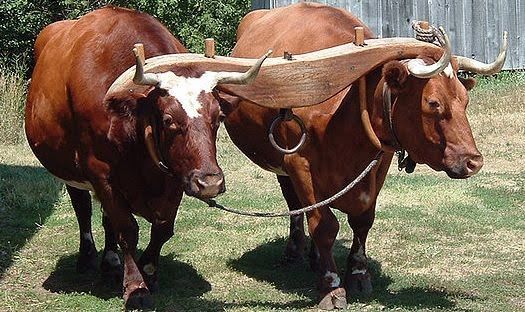
P –“What I understand by unequally yoked, is that it is like a farming term. When two oxen have a yoke between them, this is done to help pull the rake or comb used for harvesting and planting. But if it were, let’s say a duck and an ox, that’s unequally yoked, with the ox being far stronger than the duck, but it is the ox that is dragged back because the duck can’t pull its weight. I don’t necessarily see it as telling us to dissociate ourselves with unbelievers, but rather being carefully not to be influenced by them, through being in partnership with them.”
“Paul drew his analogy from Deuteronomy 22:10, where the Mosaic Law commanded the Israelites, “You shall not plough with an ox and a donkey together.” Those two animals do not have the same nature, gait, or strength. Therefore, it would be impossible for such a mismatched pair to plough together effectively. Nothing in the context would lead to the idea that he is referring to earthly issues of human endeavours. In Paul’s analogy, believers and unbelievers are two different breeds and cannot work together in the spiritual realm. He called for separation in matters of the work of God since such cooperation for spiritual benefit is impossible. The false teachers were eager to blend the people of God with the pagan worshipers, because that hinders the gospel. That is what this text forbids.” (Macarthur)
Hmm I think I get it. So in Paul using this metaphor, and telling us not to be unequally yoked, is he saying there is no value in an equal partnership with unbelievers? He says it himself: “For what partnership has righteousness with lawlessness? Or what fellowship has light with darkness?” Even if we were to look at verse 17, it concludes the thought commanding us to “come out from their midst and be separate.”
So with all this is mind, what I want to know is this: Do I have to separate and stop being friends, or even interacting with people if they’re not saved?
Well, we’ll see in Part 2.
 My Sunday Skl